Period: One autumn games evening, Sigtuna, the 1960s3 min readPublished:
The Polonaise Was Only the Heats. The Walk Home Counted.
At a Sigtuna boarding school in the 1960s, games evenings in the gym ended with a polonaise. Being asked was one prize. The walk back to the boarding house was the other.
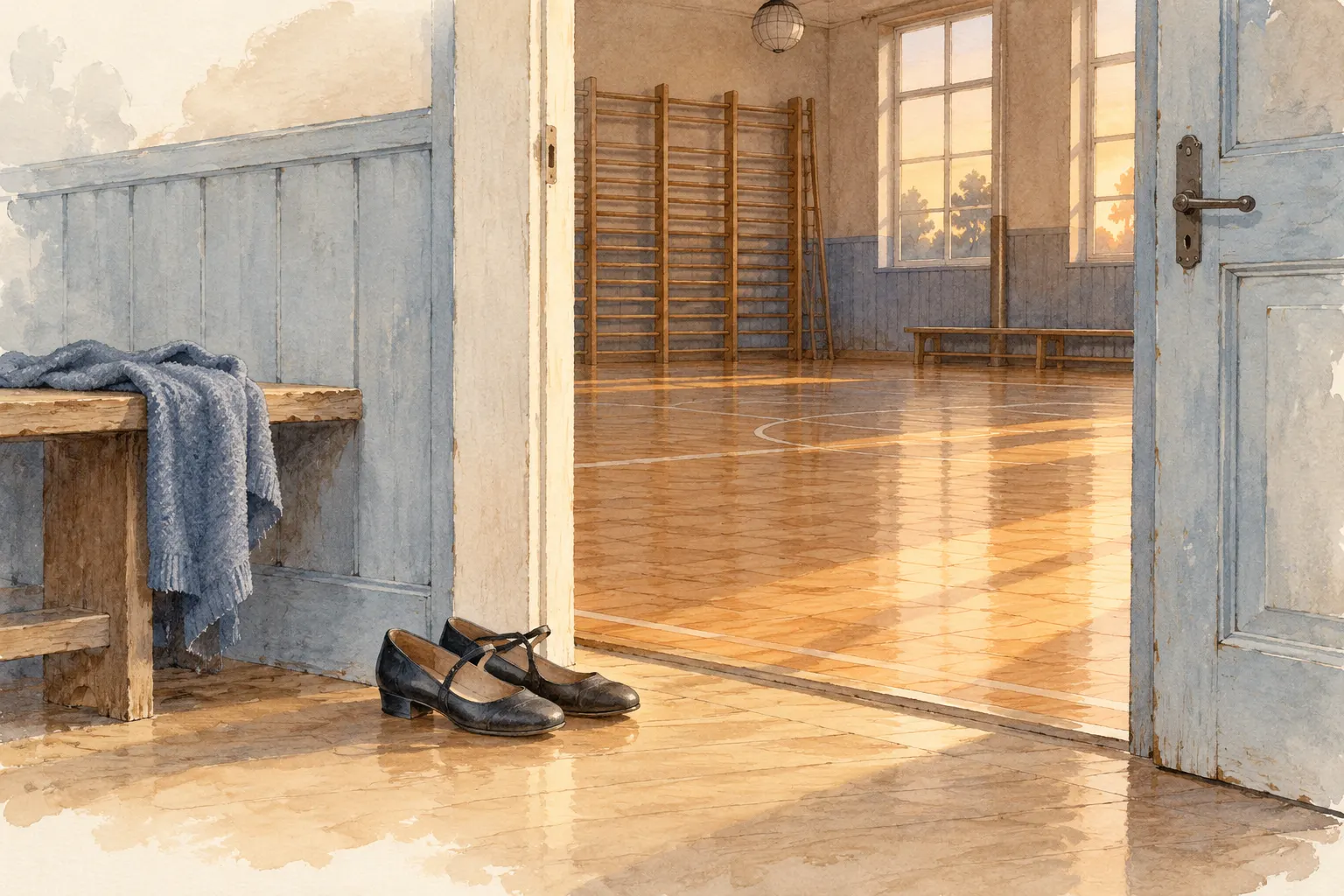
In the 1960s the boarding school in Sigtuna that later became Sigtunaskolan held games evenings, lekaftnar, two or three times a term. For one evening the gymnasium stopped being a gymnasium, and at the end of it came the polonaise.
A polonaise is not a disco. It is a procession. Couples form up and walk the length of the hall in time, under the ropes and past the vaulting boxes, in front of everyone, including the staff. Being asked meant walking beside the person who had asked you. Not being asked meant the wall bars.
But the polonaise was only the qualifying round. The real prize came after.
The boy who had asked you to the polonaise might walk you back to your boarding house when the evening ended. That was the custom, and in a former pupil’s memory it was the whole point. Sigtuna in autumn is dark early. The walk from the gym to the girls’ house took, at a normal pace, a few minutes.
Four minutes at a normal pace, which nobody used.
At the door, he might kiss you on the cheek. It was rumoured that some got further. Then the door closed, and upstairs were roommates who had been waiting, at the window, for precisely this.
I have studied the walk home as a parent, because it has been redeveloped. When the eldest went to his first school dance in Brussels, the walk home was replaced by a lift home, from me, in the car, at 10.30, parked where everyone could see it.
He asked me to park round the corner. I parked round the corner. He then asked whether I could “not be in the car” while he walked a girl from his class to her mother’s car, which was parked, he pointed out, directly outside.
I agreed to lie down across the front seats.
I lay there for six minutes. Six. The walk from the school door to the girl’s mother’s car is, by my later measurement, forty metres. Somewhere in those forty metres, with no polonaise, no ropes and no vaulting boxes, the Sigtuna tradition was fully observed, at a pace nobody used.
He got into the car. I sat up. He said: “Were you lying down the whole time?”
I said yes. He said, “Good,” and then, after a long pause, “Cheek.”
I did not ask which cheek. I have learned that much from Sigtuna. Some things belong upstairs, with the roommates, and the mother in the car is not on the bench.
He has since asked if the school will hold another dance this year. I have asked if I can bring a cushion.
About this story: the scenes and dialogue are imagined or freely retold. Facts about the schools mentioned come from published sources, which our school profiles cite.