Period: Autumn 1843, as recalled in 18933 min readPublished:
He Passed the Entrance Exam. Then Came the Wig.
In autumn 1843 a country boy passed the entrance examination at Schulpforta and shook hands with every teacher. That evening he was told there was one more test, in singing.
In autumn 1843 a pastor drove his son through the gate of Schulpforta, the famous boarding school near Naumburg. Bernhard Rogge described that gate fifty years later in his memoir: dark, unlovely, a black throat in the walls.
The boy had only ever been taught privately. There was a real chance he would not be up to the school’s lowest class. The headmaster, Dr Kirchner, asked the father what he intended to do if his son failed. A good general, he said, plans for defeat as well as victory. The father had made no plans at all.
Kirchner had one ready: a pastor in the village above took in boys who were not quite ready, and the place would be kept open for six months.
It was not needed. Rogge passed, second from bottom of the lowest class, as he is careful to record.
Then came the ceremony. The whole teaching staff attended, the headmaster spoke about the high dignity of a Pforta boy, and each newcomer shook every teacher’s hand. Rogge’s father, who had spent years trying to keep his children humble, later told him the speech had collided badly with his principles.
He need not have worried. That evening the newcomers were told there was a further examination, in singing, and that staying depended on the result.
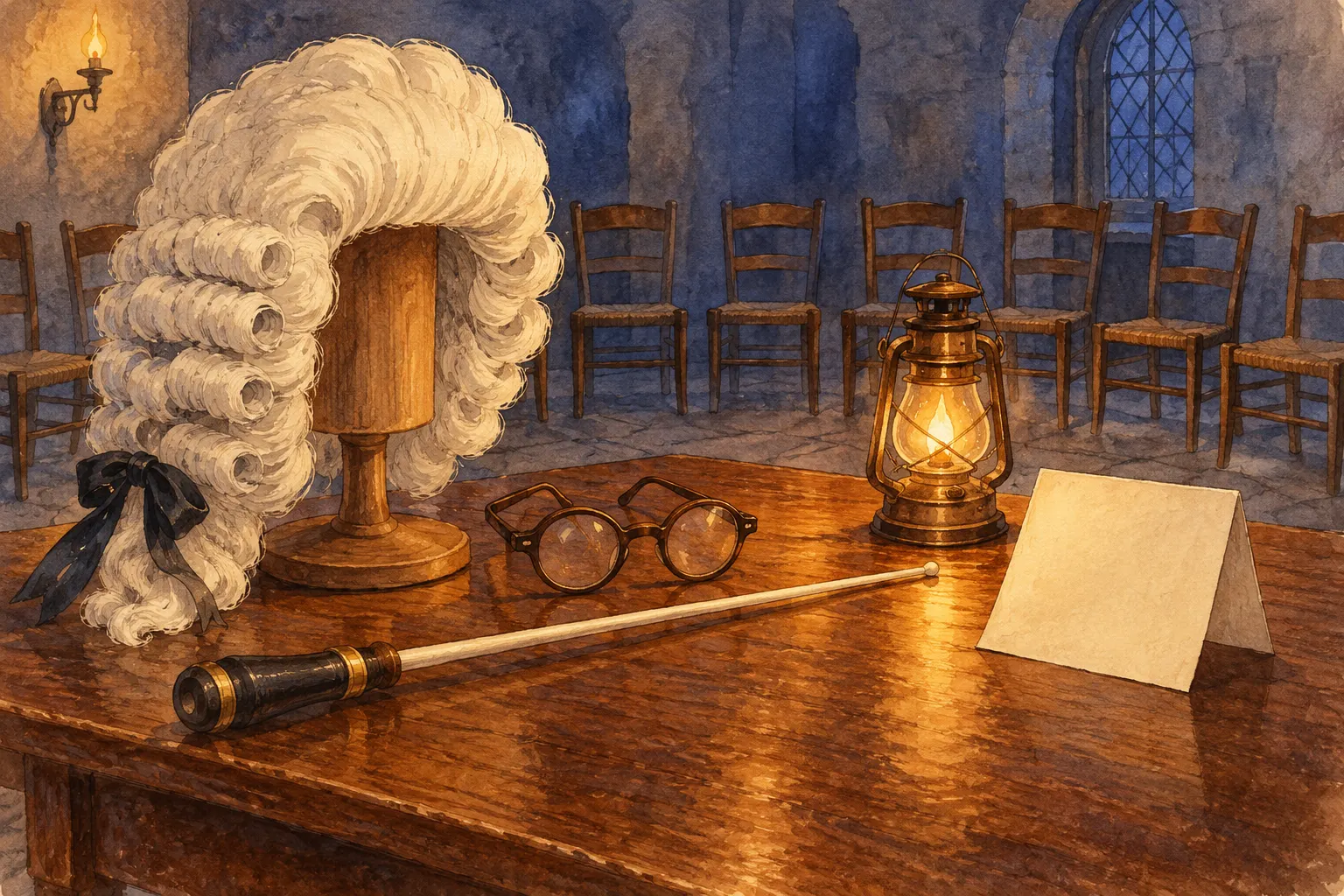
After supper they were led into the middle of a half-circle of senior pupils. Silence was ordered. In came an older boy playing the music director: an enormous wig, a collar so high it was nicknamed a “father-murderer”, huge horn-rimmed spectacles and a baton of tremendous size. Behind him came an assistant with a lantern and a list.
Each newcomer was questioned, tested, and assigned to the fifth singing class, or the tenth, or the seventy-seventh, none of which existed.
Rogge, whose singing was wretched, believed every word. Nobody in the room needed to be a good actor, because the wig did the acting. In the end the senior pupils found mitigating circumstances in his youth and admitted him on probation.
A few days later he met the real music director, Herr Kötschau, and was struck by the resemblance, at least in one respect: a black coat that reached right down to his feet.
I put my own children through a version of this every September, without the wig. I call it the first-week briefing. I review the timetable, the uniform and the house rules with a gravity entirely unjustified by its content. Last year the youngest listened to the whole thing and then asked whether there would be a singing test.
There was not. There is now. I hold it in the kitchen, with a wooden spoon for a baton. The youngest has been placed in the seventy-seventh class. She has appealed.
About this story: the scenes and dialogue are imagined or freely retold. Facts about the schools mentioned come from published sources, which our school profiles cite.