Period: May 20223 min readPublished:
Seventh-Graders Interviewed a Minister, Then Another Asked for a Selfie
In May 2022 pupils from Grünerløkka school in Oslo went to the Storting to interview the education minister. They had prepared questions. They had not prepared for the foreign minister.
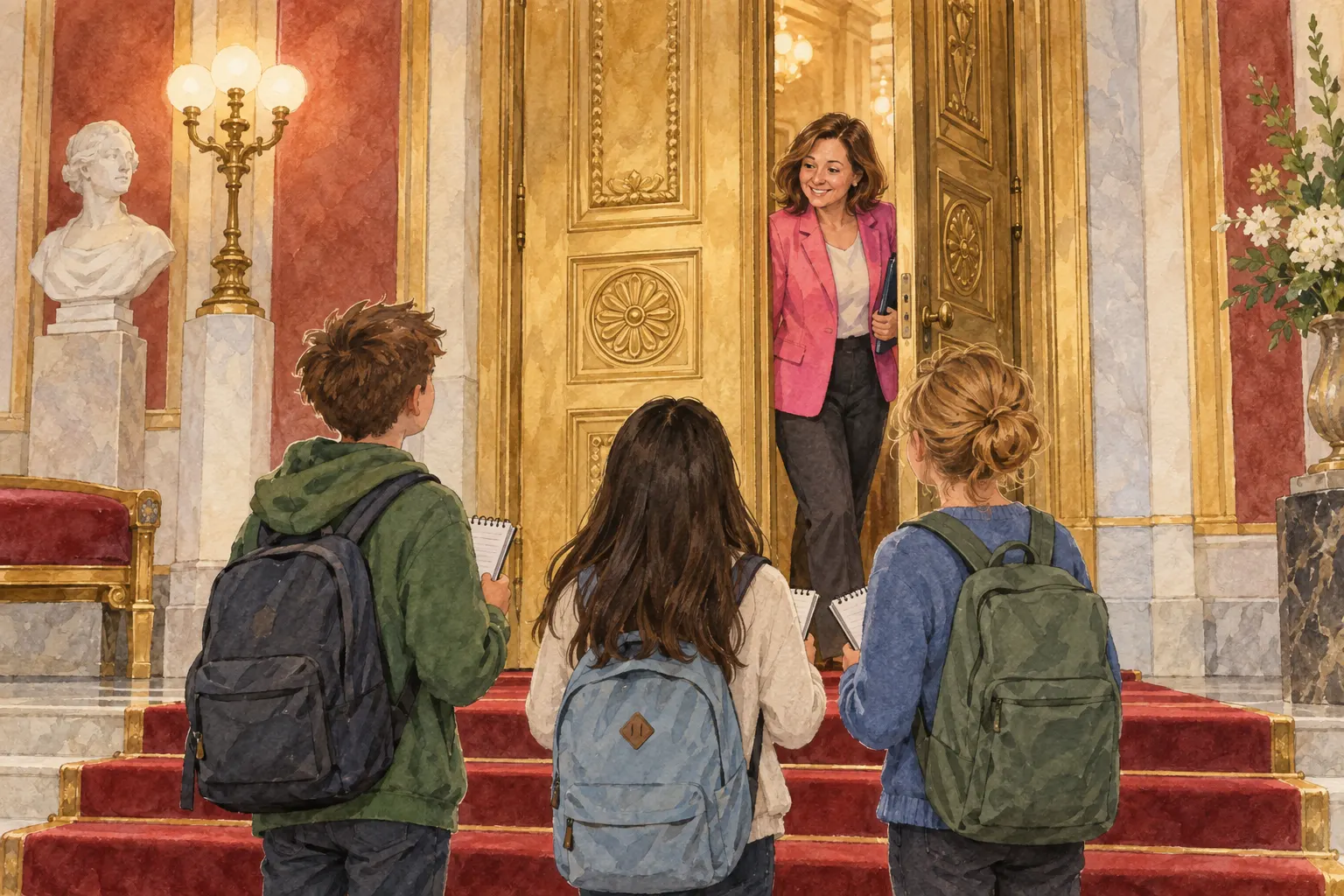
In May 2022 three seventh-graders from Grünerløkka school in Oslo went to the Storting, Norway’s parliament, to interview the education minister, Tonje Brenna. One asked the questions, one wrote the story, one took the pictures. That is a proper newsroom. Most adult newsrooms cannot manage that.
The minister wanted school to be less boring and more practical for pupils in grades five to ten. One of the pupils asked why the youngest children did not have the same problem. The minister said that was a very good question. First-graders, she said, look forward to school. Things can get duller as children grow up.
Then a gold door opened.
Out came a woman in a bright pink jacket. Their teacher recognised the foreign minister, Anniken Huitfeldt. The pupils did not. The foreign minister offered a selfie, took the photograph herself on the photographer’s phone, and then spent several minutes explaining things the girls could not follow, while they tried hard to look neither confused nor rude.
They had come to interview a minister and were photographed by a different one.
Then she asked whether they had any more questions, and moved off towards a television camera. One of the pupils quietly admitted she was confused. They put that in the story too, which is the most honest sentence in Norwegian political journalism that year.
The project was part of the school’s local-community week, an online newspaper made by seventh-graders. The journalism magazine Journalisten reported that they had produced five pieces in about three hours, and that political journalists were sharing and praising their work. The pupils told the magazine they had simply written what they thought and experienced without overthinking it.
I have overthought every piece of writing I have ever produced, including the note to the youngest’s teacher this morning about a missing glove, which went through three drafts and ended up longer than the glove.
What struck the pupils most, they said, was not the national attention. It was parents, and parents’ friends, discovering that the stories were being talked about online.
This is the true reach of school journalism. A minister’s office is one audience. The family WhatsApp group is another, and it is far harder to please.
When the youngest’s class newsletter printed her piece about our kitchen, “My Mum Cannot Find Anything”, it reached my mother in under an hour. She rang to ask whether it was true. I said it was satire. The youngest, on the extension, said it was investigative.
About this story: the scenes and dialogue are imagined or freely retold. Facts about the schools mentioned come from published sources, which our school profiles cite.