Period: April 1982 to June 19853 min readPublished:
Three Years Arguing With His Father About Being a Composer
In 1982 a fourteen-year-old at the John F. Kennedy School in West Berlin started writing a musical about a frog prince from outer space. His father kept calling him a composer, and he kept saying no.
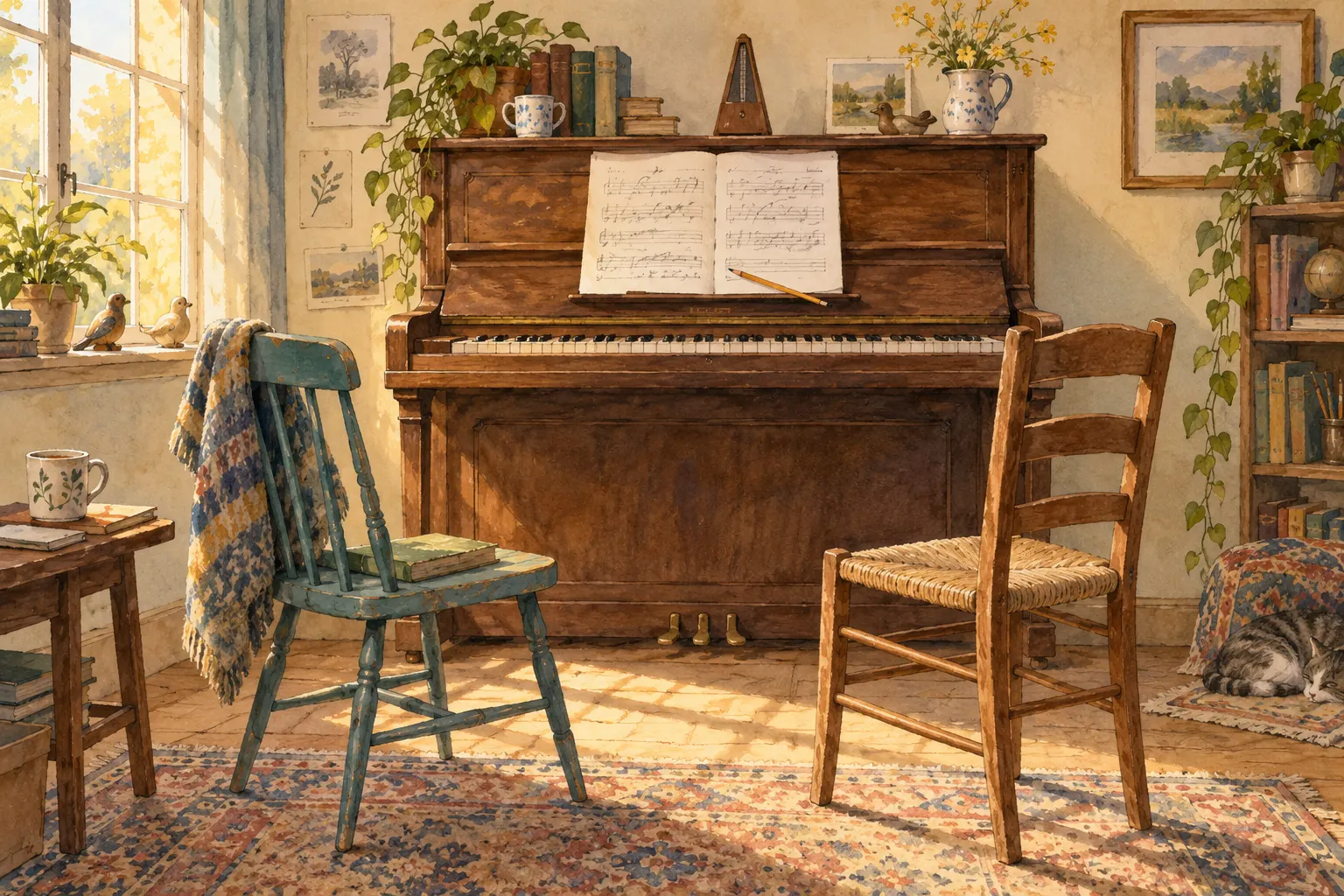
Most parents spend years bracing for the day their child announces they want to be an artist. One West Berlin father had the opposite problem. His son was an artist, and would not admit it.
The boy was fourteen, in ninth grade at the John F. Kennedy School, the German-American school in West Berlin, in April 1982. There was a composing club on Fridays at lunchtime. He brought a song to it about a prince from outer space who is turned into a frog, a story he had been working on for years. The music teacher heard it and said, in effect: so write a musical.
He said that was mad. He was fourteen. Then he went home and wrote more songs.
His parents heard each one as it arrived, and his father delivered his verdict: a real composer. No, said the son, just a kid messing about. The argument ran, on and off, for three years.
I have had this argument in my own kitchen, with the roles the right way round. The middle one wrote a song last year, in the car, about a goat. I called it catchy. She said it was “a serious piece about loss”. I asked which loss. She said the goat’s, obviously, and stopped speaking to me until Antwerp.
The trouble with the Berlin boy’s position was that he did not hold it. When the tune had a note that sat oddly, and the adults suggested changing it, he refused. He was too young to be a composer and old enough to overrule two adults on a single note.
A musical needs a stage, which in a school means teachers willing to carry it. The John F. Kennedy School gave him a production of his own in June 1985: the auditorium, the time and a budget that would not have stretched to a real frog. He did the directing. He cast six friends as a troupe of travelling players performing the fairy tale, so that six people could cover every part, in full view, by running behind things.
There was no money for a copyist. So the parts for the pupils in the pit were copied out by hand, at the family’s dining table, by his mother, friends and the music teacher who had said “write a musical” in the first place, and was still there at the end, doing its paperwork.
Somewhere in the run of the show, at the piano, with the frog singing his song, sour note and all, the boy understood that his father had been right all along.
I would like to report a similar breakthrough with the goat. Last week the middle one performed it at a school concert, to applause, and in the car on the way home I said, carefully, that she was quite the songwriter.
She said, “It’s a requiem.” I said yes. We are speaking again. The goat is in its third movement.
About this story: the scenes and dialogue are imagined or freely retold. Facts about the schools mentioned come from published sources, which our school profiles cite.