Period: A mountain village, 1960s3 min readPublished:
Eighteen Pupils, No Abacus, and a Pocketful of Chestnuts
In the 1960s a twenty-year-old teacher fresh from college in Skopje took charge of a one-room school in a mountain village. Her method book assumed an abacus.
In the 1960s a young woman of twenty finished teacher training in Skopje and was posted to a village school under the mountains: one class, all ages, eighteen children.
She brought a suitcase, a certificate and a book on teaching method. The method book had a lot to say about the abacus. The school did not have an abacus.
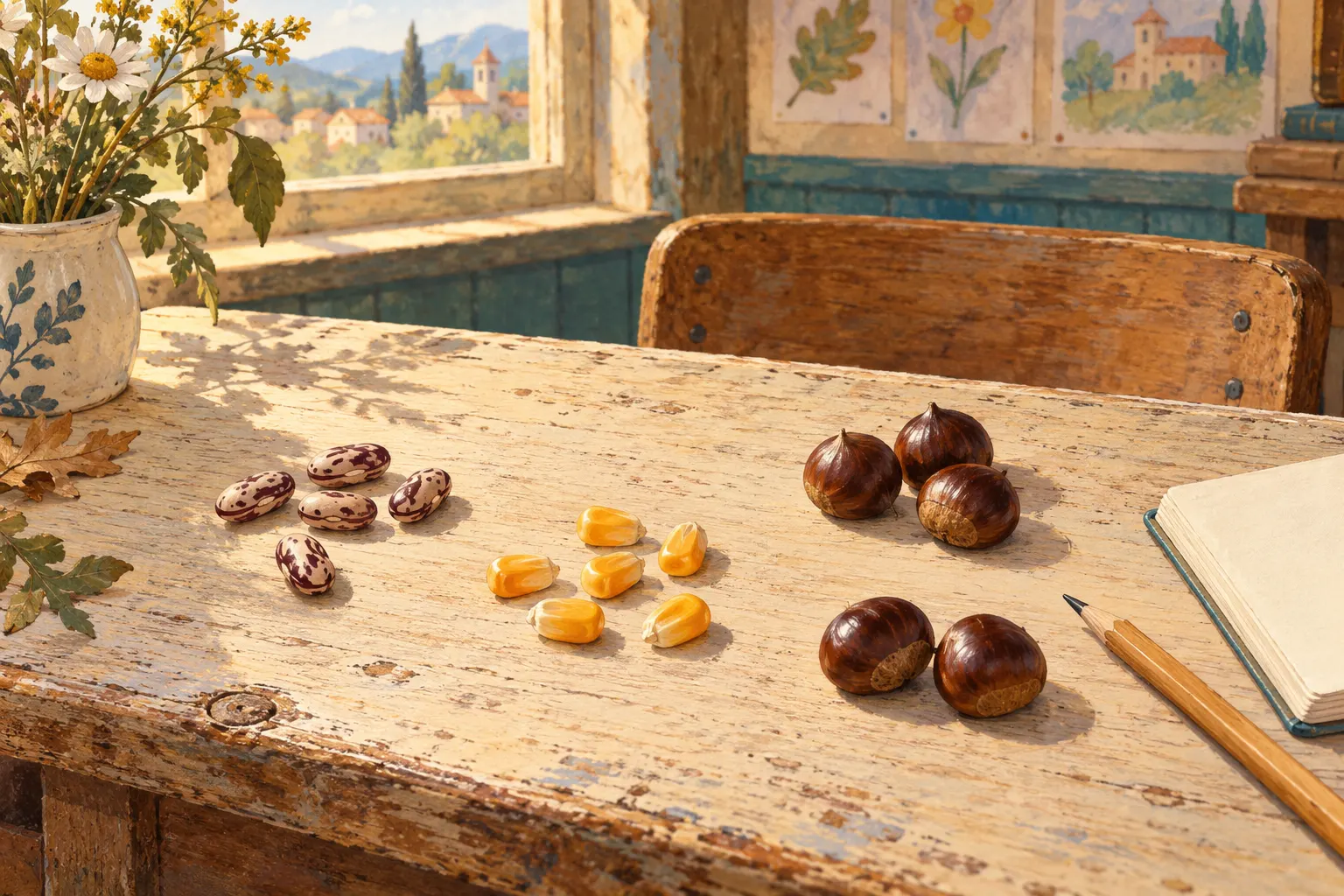
Arithmetic, it turned out, was not fussy about equipment. She asked the children to bring beans. The next day they came with beans, maize and, from a family with a tree, chestnuts.
Two beans and three beans made five beans. Five beans minus two chestnuts is either a maths problem or the beginning of economics.
When the weather was good, lessons moved outdoors, where the method book had nothing to say. She asked the children how their mothers made cheese: how the milk was soured, how you could tell when it was ready. On this subject they were the senior staff and she was the pupil.
They were astonished to have a teacher who listened.
By spring they could read. Not all at the same speed, but they could put a page of the primer together. At the end of the day she walked down the village street with children holding both hands, and the mothers at the gates, who had been suspicious of a girl from the city with a certificate, nodded.
She taught for forty years after that, in bigger schools with abacuses. When asked about the first year, she remembered the beans, the chestnuts and the cheese.
I have home-taught maths with household objects, during a week of school strikes in Madrid. I used pasta. The youngest, then six, ate the subtraction. The middle one built the multiplication into a tower. The eldest, asked to calculate fractions of a pizza, asked for the pizza.
I tried the cheese method too. I asked the children to teach me something they knew and I did not. The eldest explained an online game for forty minutes, with diagrams. The middle one explained a pop group’s internal politics. The youngest explained how to make slime, then made it, on the kitchen table, where it remains in part.
I was, like the Macedonian teacher, astonished. I learned a great deal. I would not, however, describe myself as the senior staff.
The village teacher learned from her pupils and became a better teacher for forty years. I learned from mine and now own a large bag of slime activator. The youngest has asked whether I would like a lesson on chestnuts.
About this story: the scenes and dialogue are imagined or freely retold. Facts about the schools mentioned come from published sources, which our school profiles cite.