Period: Dublin, 1952–573 min readPublished:
The New Maths Master Drew a Seating Plan. Everyone Moved.
In 1950s Dublin, a new maths master at St Andrew’s College mapped every boy to his desk in the first lesson. By the second lesson the map was useless.
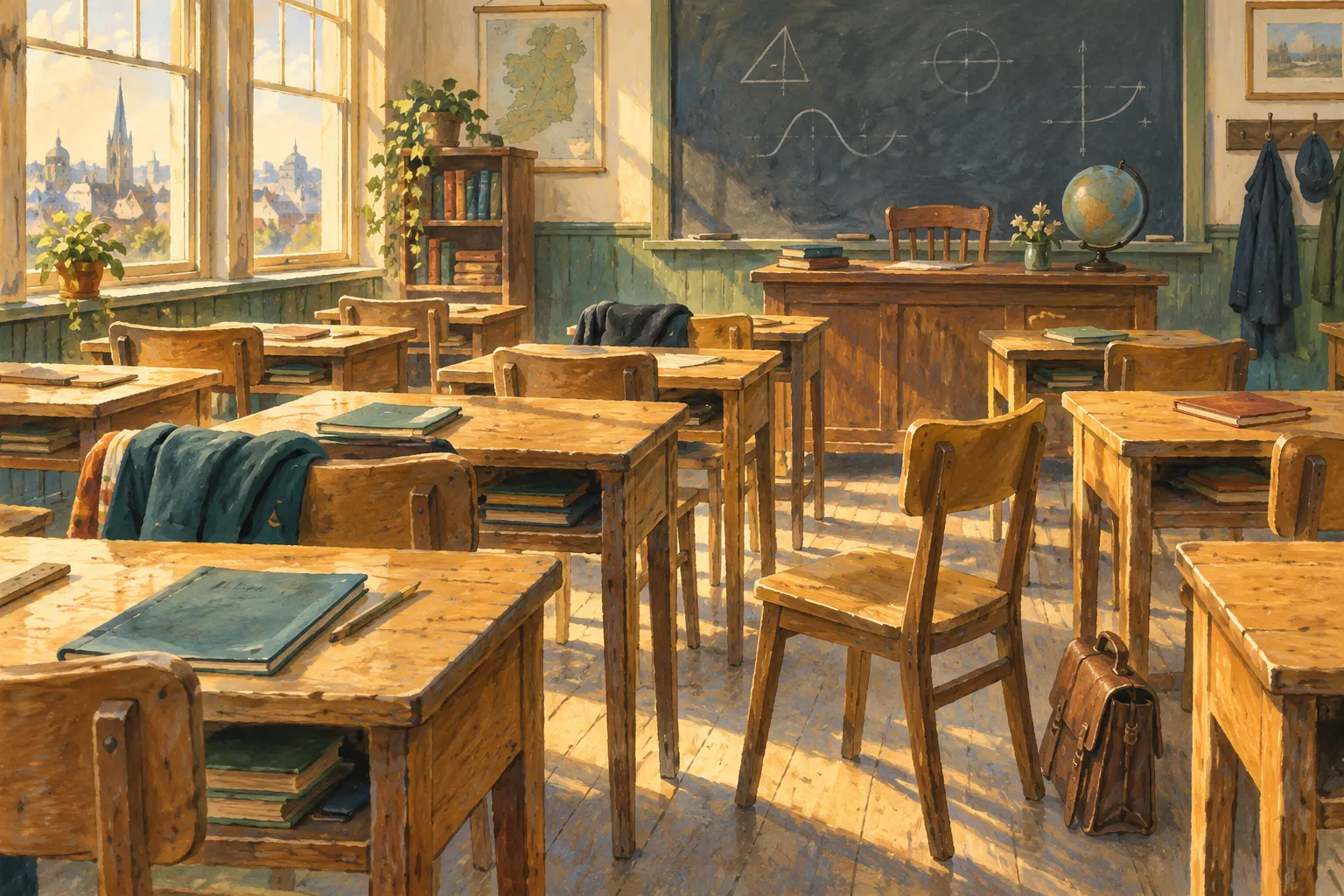
In September 1952 a twelve-year-old started as a day boy at St Andrew’s College in Dublin. The school then lived in three tall old houses knocked together on Clyde Road in Ballsbridge, so the forms stayed put and the masters moved, carrying their books from house to house like doctors on ward rounds. A boy’s desk was his address.
Then a new maths master arrived. He had read mathematics at Oxford and had been teaching in Iran until politics there made it wise to leave.
In his first lesson he did something no master had done before. As he took the register, he drew a small plan of the room and wrote each boy’s name in his place. By the end of the lesson he could look up and name anyone.
He saw this as a courtesy. The boys saw it as a challenge.
Before the next lesson, every boy in the room changed desks.
The master came in, opened his notebook, looked at the plan, looked at the room and called out a name to the wrong boy. Then he began, slowly, to smile. He put the plan away and never used it again. He learned them after that by their faces and their mistakes, which is how teachers learn names that last.
The boys had moved desks to defeat the plan, and it took the master five years to win the room back.
He did it with mathematics. The boy who told the story was good at maths, and under this master he became interested, which is better. He was set problems that were not in the book. Praise was rationed to a single “Yes”, which made it worth having.
Near the end of the boy’s five years, the master decided to leave. Before he went, he made an offer, quietly, on a landing: he would stay one more year, if the boy wanted to try for a mathematics scholarship at Trinity College, and prepare him for it.
He had begun by mapping thirty boys to thirty desks. He ended by offering to rearrange his own year for one of them.
I have tried the seating plan at home, at dinner, to stop the middle one and the youngest kicking each other under the table. I drew it on the back of an envelope and stuck it to the fridge.
The next evening they swapped places. And my husband’s. And mine. I sat down at what I believed was my place, and found myself facing the fridge, the envelope and my own handwriting.
I have not got the room back. I have got as far as one “Yes”, from the youngest, when I asked whether she wanted pudding.
About this story: the scenes and dialogue are imagined or freely retold. Facts about the schools mentioned come from published sources, which our school profiles cite.